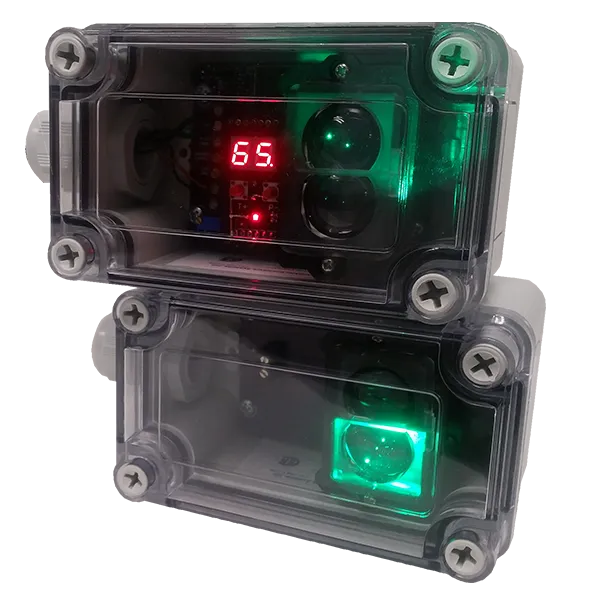
An air particulate monitor earns its place by making a ventilation system respond to conditions instead of running on a timer. A hood that runs at full speed all shift costs money it doesn’t need to spend. A hood that doesn’t ramp up when smoke builds costs something worse.
The PMX sits between those two failures. It’s a two-piece opposed sensor that measures how much light is getting from one side of a duct or hood to the other, and reports that as a signal your control system can act on. This guide covers what it measures, the specifications that decide whether it fits, how to configure it, and the applications where you should specify something else.
The PMX is a transmitter and receiver pair. The transmitter projects a 525 nm green LED beam across the space being monitored; the receiver measures how much of it arrives. Airborne particulates in the path reduce that transmission, and the drop is what the sensor reports.
That makes it an obscuration-based monitor. It tells you how heavily loaded the air is along a specific optical path, in relative terms, on a 00–99 scale. What it does not do is count individual particles or classify them by size — there’s no PM2.5 or PM10 output here, because that’s a different measurement performed by a different class of instrument.
For demand-controlled ventilation, that distinction works in your favor. A fan controller doesn’t need particle size distribution. It needs to know whether the air is getting dirtier and by how much, quickly enough to respond. That’s what the PMX provides.
The transmitter mounts up to 10 meters (33 feet) from the receiver. That span covers most commercial hood widths, duct runs, and factory vent applications. Both units are aligned so the beam focuses on the receiver, and the LED intensity is then set — LO, MED, or HI — to suit the distance and the transmission range the application needs.
Because it’s an opposed pair, both sides need mounting positions with a clear optical path between them. That’s the first thing to confirm on a site survey.
Response time is under 150 microseconds, with a 6 kHz switching frequency. For ventilation control, this is far quicker than necessary, which is the point — the sensor is never the lag in the loop. The delay you’ll see is the fan spooling up, not the measurement.
Two outputs, available simultaneously:
Most installations use the analog output for the control strategy and the discrete output as a high-load alarm.
A two-digit display shows signal strength during alignment, which removes the guesswork from mounting. Teach mode sets the detection threshold automatically. From there:
Dive Deeper: Browse EMX’s particulate monitoring applications for how the PMX is deployed in kitchen hoods, greenhouses, and factory venting.
The PMX is ordered as a housed pair or as bare boards, and the choice comes down to whether you’re installing a device or building one:
The NEMA 4X housing includes a durable window for the light path. Both units measure 130 × 78 × 78 mm (5.1″ × 3.1″ × 3.1″); the receiver weighs 408 g and the transmitter 340 g. Power is 10–24 VDC at 60 mA, with short circuit and reverse polarity protection. The IRB-325-SP liquid-tight strain relief connector set is available where the install calls for it.
Three limits worth knowing before you specify it:
It is not rated for personal safety applications. If the function you’re designing is life-safety — fire detection, occupant egress, personnel protection — the PMX is not the device, and no configuration changes that.
It doesn’t count or size particles. If your requirement is a PM2.5 figure for a regulatory filing or an air quality report, you need a particle counter. The PMX gives you relative transmission on one optical path.
It needs an opposed mount. Transmitter and receiver on opposite sides, aligned, with a clear path. Where you can’t get two mounting points facing each other, this form factor doesn’t apply.
Operating temperature is -20°C to 55°C, which covers most indoor and hood-adjacent installs but is worth checking against duct temperatures on hot processes.
Ventilation applications vary more than the spec sheet suggests — duct width, particulate type, and how heavily loaded the air gets all shift where the threshold should sit. EMX’s free sample testing applies here as much as it does to a production line sensor.
Full specifications are in the PMX data sheet. If you’re weighing the PMX against a threshold-only alternative, or working out whether the analog output fits your controller, talk to our team before you spec it.